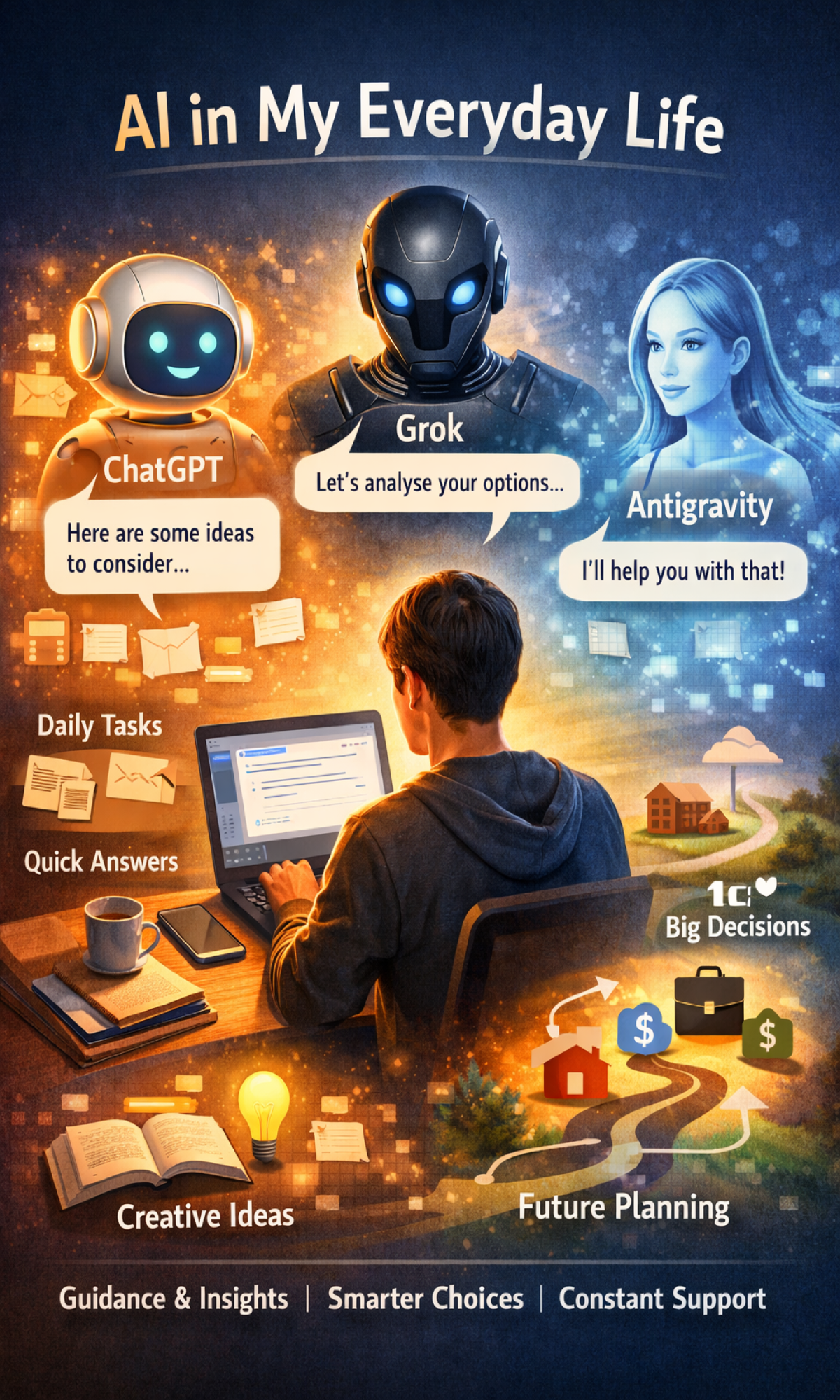
Artificial intelligence has quietly become a part of my daily life. Tools like ChatGPT, Grok, and Antigravity are no longer just technologies I experiment with. They’ve become assistants, sounding boards, and decision partners.From the smallest daily details to major life decisions, I rely on AI to think more clearly and act more confidently.
On a simple day, AI helps me draft messages, fix code errors, refine ideas, and organize my schedule. When I’m stuck on a technical issue or exploring a new concept, I can break it down instantly with clear explanations. Instead of spending hours searching for scattered answers, I get structured guidance in seconds.
For creative tasks, AI helps me write better, brainstorm smarter, and express ideas more effectively. It turns rough thoughts into refined output. It challenges my assumptions and sometimes offers perspectives I would not have considered on my own.
But the impact goes beyond productivity.
When I face bigger decisions, whether career-related, financial, or personal, I use AI as a thinking partner. I lay out options, explore pros and cons, simulate outcomes, and clarify what truly matters. It doesn’t decide for me, but it sharpens my thinking and reduces emotional bias.
What makes this powerful is consistency. AI is available anytime, never tired, never distracted. It remembers context, adapts to my style, and evolves with my needs.
In many ways, AI has become an extension of how I think. It amplifies my curiosity, accelerates my learning, and supports my growth. From everyday tasks to life-changing decisions, it plays a steady role in shaping how I move forward.
Technology once felt like a tool. Now, it feels like a companion in progress.