Kaggle / 2026
Biohub — 3D Cell Tracking During Development
A 3D microscopy pipeline for zebrafish cell detection, temporal linking, division recovery, and lineage reconstruction.
Completed
- Final rank
- 1,267
- Tracking score
- 0.91595
Finished on 30 Sep 2026 View leaderboard ↗
Final leaderboard
The challenge
My approach
Solution notes — reviewed 23 October 2026. Methods, local experiments, and competition standings are identified separately.
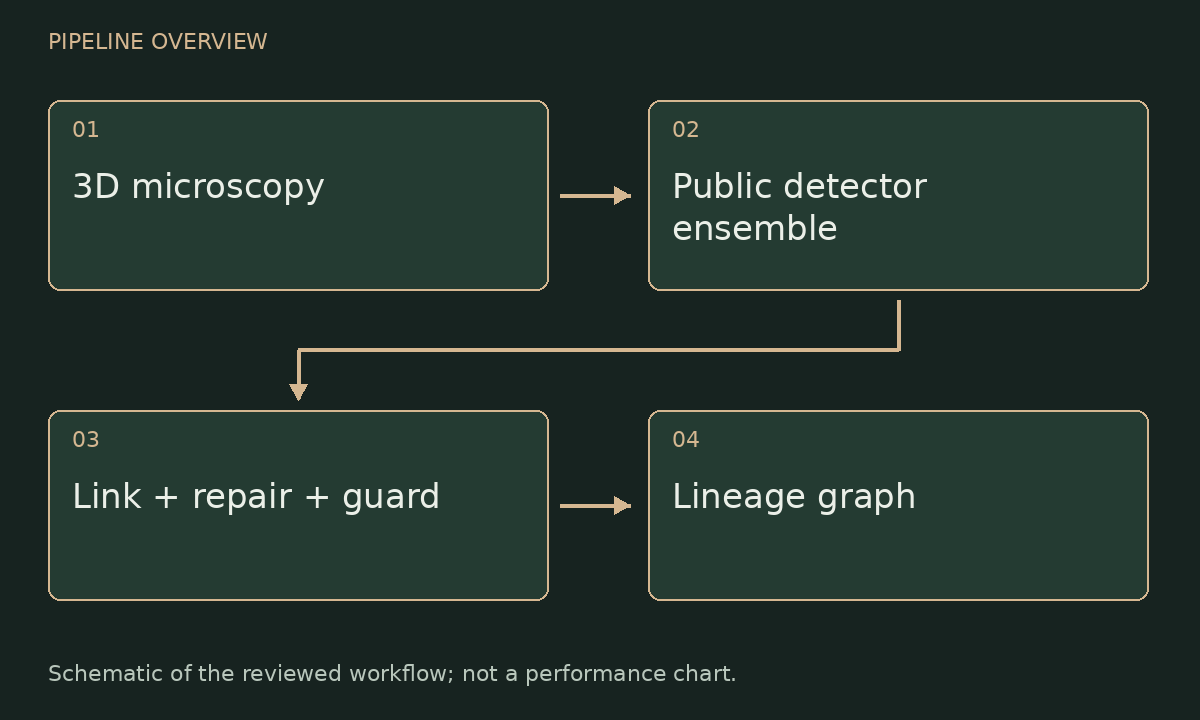
Open pipeline diagram at full size
Tracking by detection
The Biohub challenge requires a graph of cell detections and temporal links, including cell divisions, from 3D zebrafish microscopy. Errors propagate across stages: a missing detection prevents a correct link, while an incorrect repair can create an invalid lineage even when individual detections look plausible. The repository therefore treats detection, association, repair, and retention checks as distinct parts of one inference pipeline.
Public models and the project’s contribution
The advanced notebook derives from Reyhan Ksatria’s credited public 0.947 pipeline. Its detector checkpoints come from public support datasets, including a primary TemporalUNet3D source, a secondary seed, and a DeepCenter center-prior model. ARTIFACTS.md states that these weights were not trained in this repository. The contribution described here is the integration, parameter exploration, runtime/configuration management, metric replay, and diagnostic checks around those components.
Detection, association, and repair
The recorded approach combines dual-seed detector evidence with bidirectional probability fusion. Association uses global linking, motion-aware relinking, node-transformer features, and spatial test-time augmentation. Repair steps include division recovery, gap closing, and short-track rescue. The retention report tracks how much of the candidate detection set survives each frame and supports a fallback when a processing change removes too much evidence. This makes silent data loss visible instead of letting it masquerade as a cleaner prediction.
A measured local change
ppsweep_selected.json selects tight55, setting MOTION_RELINK_TIGHT_UM to 5.5. Across the eight recorded held-out stems, the stored proxy moves from 0.948689 to 0.950749. Those numbers describe a local parameter sweep; they are not an independent final competition score or proof that every repair helps every movie. The repository retains selected settings and run-state snapshots so the chosen configuration can be reconstructed.
Submission identity and final result
The artifact record preserves the final submission’s SHA-256 and a row count of 241,557. It records public score 0.94741 and public rank 1,344. The completed private leaderboard, checked separately on 23 October 2026, shows rank 1,267 and score 0.91595. The public, private, and local-proxy numbers are deliberately separated because they evaluate different data and different stages of the workflow.
Reproducibility and limits
Large local predictions, model files, and logs were removed after the competition; the artifact record points to public checkpoint sources and regeneration steps. That is useful provenance, but it is not a complete retained execution environment. The practical lesson is to preserve both graph integrity checks and an exact submission identity, and to credit borrowed model weights as clearly as the locally authored changes.